 Business License

DAIER VOC Treatment Solutions Plastic Hexagonal Composite Ring Packing for Scrubber Systems
H1: VOC Treatment in Scrubber Systems: Engineering the Gas-Liquid Contact with Plastic Hexagonal Composite Ring Packing | Pingxiang Daier
H2: The Engineering Challenge in VOC Scrubbers
Volatile Organic Compound (VOC) treatment via wet scrubbing is a gas-liquid mass transfer operation. The scrubbing liquid (water, caustic, or chemical solvent) absorbs VOC molecules from the gas stream. The efficiency of this operation is determined by one variable: the quality of gas-liquid contact within the packed bed.
Poor contact means:
VOC slip — untreated compounds exiting the stack
Higher liquid circulation rates to compensate — increased pumping energy
Larger tower diameter to maintain residence time — higher capital cost
Frequent packing replacement due to fouling or structural failure
The packing media is the interface where absorption happens. Its geometry, void ratio, surface characteristics, and material compatibility dictate the mass transfer rate, pressure drop, and long-term operational reliability.
At Pingxiang Daier Separation Tech Co., Ltd. (spelled D-A-I-E-R) , we approach VOC scrubber packing not as a commodity, but as an engineered interface. This article examines how the plastic hexagonal composite ring (Lanpack Ring / Hexagram Ring) addresses the specific demands of VOC treatment systems.
H2: Why Hexagonal Geometry for VOC Service?
H3: Geometric Structure
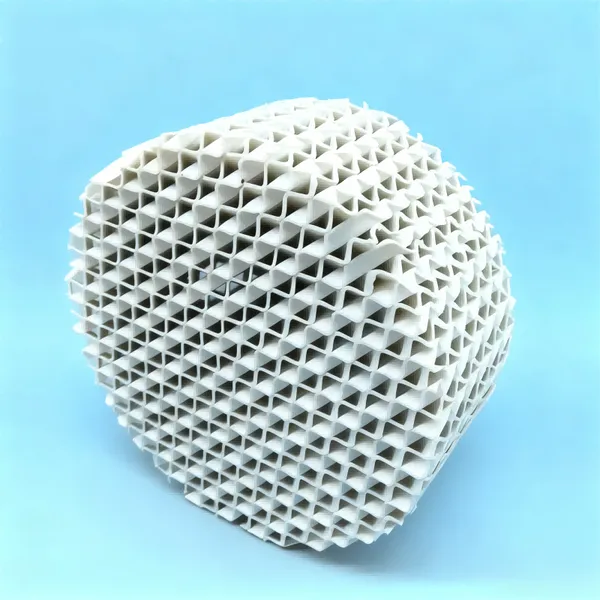
The plastic hexagonal composite ring is an injection-moulded packing element featuring a hexagonal prism structure with internal support ribs. Each individual ring functions as a mini-structured packing unit. When loaded into the tower, the geometry promotes self-alignment and ordered arrangement — combining the installation convenience of random packing with the mass transfer efficiency of structured packing.
H3: Mass Transfer Efficiency
The hexagonal internal structure creates turbulent gas-liquid mixing and maximizes interfacial
area. The droplet-point design significantly increases the effective gas-liquid contact area per unit volume. Higher mass transfer efficiency means:
Lower packed height required to achieve the same VOC removal efficiency
Smaller tower diameter for the same gas throughput
Reduced solvent circulation rate — lower pumping energy
H3: Pressure Drop Characteristics
Void ratio is the primary determinant of pressure drop across a packed bed. The hexagonal composite ring achieves a void ratio ≥ 92–97% (depending on size). Lower pressure drop translates directly to:
Reduced blower or fan energy consumption
Lower compression costs in pressurized systems
Ability to retrofit existing towers with higher gas throughput without exceeding fan capacity
H3: Anti-Fouling and Anti-Stacking
VOC streams often carry particulate matter, tars, or polymerization-prone compounds. The open geometry and smooth surfaces of the hexagonal ring reduce solids accumulation. Additionally, the design prevents ring-to-ring nesting or interlocking during operation — a common failure mode in other plastic packing types that causes channeling, efficiency loss, and premature replacement.
H2: Material Selection for VOC Service
VOC scrubbers handle a wide spectrum of chemical environments — from water-soluble alcohols to aggressive chlorinated solvents and acidic compounds. Material selection is the first engineering decision.
DAIER manufactures the hexagonal composite ring in multiple thermoplastics, each suited to specific VOC service conditions:
| Material | Max. Operating Temperature | VOC Service Suitability |
|---|---|---|
| PP (Polypropylene) | ≤ 100°C | General VOC scrubbing, water-soluble VOCs, non-aggressive organics |
| RPP (Reinforced PP) | ≤ 120°C | Higher-temperature VOC streams, enhanced mechanical strength |
| PVC | ≤ 60°C | Low-temperature VOC service, acid gas co-absorption |
| CPVC | ≤ 90°C | Chlorinated VOC streams, oxidizing environments |
| PVDF | ≤ 150°C | Aggressive organic solvents, strong acids, extreme chemical environments |
| PTFE | ≤ 260°C | Universal chemical resistance for the most aggressive VOC applications |
DAIER provides full material certification and batch PMI (Positive Material Identification) testing for all plastic packing shipments.
H2: Performance Data: What Engineers Need to Know
H3: Hydraulic Parameters (Typical Values)
| Parameter | 50mm Size | 76mm Size | 100mm Size |
|---|---|---|---|
| Dimensions (D×H×T, mm) | 50×22×1.3 | 76×34×1.8 | 100×45×2.5 |
| Specific Surface Area (m²/m³) | 258 | 198 | 158 |
| Void Ratio (%) | ≥ 97 | ≥ 96.5 | ≥ 96 |
| Packing Factor (m⁻¹) | 283 | 220 | 179 |
H3: Key Performance Indicators for VOC Scrubber Design
Pressure Drop: The high void ratio minimizes gas-phase resistance. For a typical VOC scrubber operating at 70% flood, the pressure drop across a DAIER hexagonal ring bed is significantly lower than conventional Pall Ring or saddle-type packings at equivalent gas loads.
HETP (Height Equivalent to a Theoretical Plate): The hexagonal geometry provides enhanced gas-liquid interfacial area, resulting in lower HETP values compared to conventional random packings — meaning shorter packed height for the same separation duty.
Turn-Down Ratio: The self-aligning characteristic of the hexagonal rings maintains performance across a wide range of gas and liquid loads, providing operational flexibility for variable VOC concentration and flow rate.
H2: Field Application: VOC Scrubber Retrofit
H3: The Challenge
A chemical processing plant operating a 2.4m diameter VOC scrubber was experiencing VOC slip above permit limits. The existing Pall Ring packing had been in service for 6 years and showed signs of fouling, channeling, and reduced mass transfer efficiency. The plant faced two options:
Install a new, larger scrubber — high capital cost, extended downtime
Retrofit the existing tower with higher-efficiency packing
H3: The DAIER Solution
The plant replaced the existing Pall Rings with DAIER plastic hexagonal composite rings (76mm size, PP material) without modifying the tower shell, liquid distributors, or support grids.
H3: The Result
VOC removal efficiency improved without increasing tower height
Pressure drop across the packed bed decreased by approximately 25–30% (calculated based on void ratio differential)
The anti-fouling geometry extended the expected packing service life
The retrofit was completed during a scheduled turnaround — zero additional downtime
H2: Engineering Support from DAIER
DAIER provides process engineering support beyond packing supply:
Packing Selection: Based on VOC composition, temperature, pressure, and liquid chemistry
Hydraulic Calculations: Pressure drop estimation, flooding velocity, F-factor analysis
HETP Estimation: For distillation and absorption applications
Tower Sizing: For new installations or retrofit evaluations
Installation Guidance: Technical drawings, layout support, on-site troubleshooting
All DAIER plastic packing is manufactured under ISO 9001:2015 certified quality systems, with full material traceability and EN 10204 3.1 certification available per batch.
H2: Manufacturing & Logistics
DAIER operates with a coordinated structure:
Pingxiang, Jiangxi, China — primary manufacturing base, located in the country's industrial ceramics and chemical packing hub
Xiamen — export and international business center
Taiwan — technical support and engineering background
Standard sizes available from stock; custom fabrication supported per project requirements. Products are exported to Europe, North America, the Middle East, and Southeast Asia.
H2: Conclusion: Engineering the Interface
VOC treatment is not about "buying packing." It is about engineering the gas-liquid interface to achieve the required mass transfer duty at the lowest total cost — capital, energy, and maintenance.
The plastic hexagonal composite ring from Pingxiang Daier Separation Tech (D-A-I-E-R) addresses the core engineering variables:
Geometry — maximizes interfacial area
Void ratio — minimizes pressure drop
Material — matches the chemical environment
Anti-fouling design — extends service life
When engineers specify DAIER packing, they are not specifying a commodity. They are specifying an engineered solution to a mass transfer problem.
Recently Posted
-
Pingxiang Daier Engineering Guide: Optimizing Process Efficiency with Plastic Pall Ring in Scrubbers
September 18, 2026Introduction: The Engineer's Dilemma - Pressure Drop vs. HETPIn the design and retrofitting of chemical process systems, a com Read More
 -
Pingxiang Daier Engineering: How Ceramic Cascade Mini Rings Optimize High-Temp Acid Scrubbing Efficiency
September 18, 2026Introduction: The Engineering Limitations of Standard Packing in Aggressive EnvironmentsIn chemical process systems such as flue g Read More
 -
Pingxiang Daier Engineering: How Plastic Super Intalox Saddle Rings Solve Scrubber Tower Bottlenecks
September 16, 2026Introduction: The Challenge of Capacity Bottlenecks in Scrubber TowersIn environmental engineering and chemical process systems, p Read More
 -
Pingxiang Daier Engineering: Optimizing Gas Scrubbing Efficiency & Pressure Drop with Plastic Intalox Saddle Ring
September 15, 2026Introduction: The Engineering Challenge of Column InternalsIn chemical process systems, optimizing mass transfer while minimizing Read More

Contact Us
Recommended Products
-
 Pingxiang Daier Plastic Pall Ring | High-Throughput Random Packing for Gas Scrubbing & Mass Transfer SolutionsNegotiableMOQ: 1 Cubic Meter
 -
Pingxiang Daier Ceramic Berl Saddle | High-Temperature Acid Resistant Random Packing for Mass Transfer SolutionsNegotiableMOQ: 1 Cubic Meter
-
Pingxiang Daier Plastic Super Intalox Saddle Ring | High-Efficiency Random Packing for Advanced Gas ScrubbingNegotiableMOQ: 1 Cubic Meter
-
Pingxiang Daier Plastic Intalox Saddle Ring | Random Packing for Mass Transfer Solutions & Gas ScrubbingNegotiableMOQ: 1 Cubic Meter
-
Pingxiang Daier Plastic Liquid Surface Cover Ball | Mass Transfer Solutions & Tower Internals | Chemical Process Systems OptimizationNegotiableMOQ: 1 Cubic Meter
-
Pingxiang Daier Plastic Floating Hollow Ball for Acid Storage Tank & Water Treatment | DAIER SeparationNegotiableMOQ: 1 Cubic Meter
-
Pingxiang Daier Plastic Heilex Ring Random Tower Packing for Gas Scrubbing & AbsorptionNegotiableMOQ: 1 Cubic Meter
-
Pingxiang Daier Plastic Cascade Mini Ring Random Tower Packing for Absorption & ScrubbingNegotiableMOQ: 1 Cubic Meter
-
Pingxiang Daier Plastic Polyhedral Hollow Ball Random Tower Packing for Scrubbing & AbsorptionNegotiableMOQ: 1 Cubic Meter
-
Pingxiang Daier Corundum Wear-Resistance Ceramics Rotating Scraper for Balling & Bulk Material Handling | DAIER SeparationNegotiableMOQ: 1 Cubic Meter
-
Pingxiang Daier Double Labyrinth Sealed Ceramic Conveyor Roller for Mining & Bulk HandlingNegotiableMOQ: 1 Piece
-
Pingxiang Daier Plastic Perforated Plate Corrugated Structured Packing 125Y 250Y 350Y for Distillation Absorption ScrubberNegotiableMOQ: 1 Cubic Meter
-
Pingxiang Daier Light Ceramic Combination Ring Structured Packing Replaceable for Petrochemical Distillation Absorption ScrubberNegotiableMOQ: 1 Cubic Meter
-
Pingxiang Daier Plastic Hexagonal Composite Ring Structured Packing PP/PVDF for Scrubber Tower Low Pressure Drop High Void RatioNegotiableMOQ: 1 Cubic Meter
-
Pingxiang Daier Metal Corrugated Plate Structured Packing 125Y 250Y 350Y 500Y 700Y for Distillation Absorption ScrubbingNegotiableMOQ: 1 Cubic Meter

-
Pingxiang Daier Ceramic Structured Packing 100Y-700Y for Distillation, Absorption & Acid Gas ScrubbingNegotiableMOQ: 1 Cubic Meter
-
Pingxiang Daier Medium Alumina Inert Ceramic Ball (Al₂O₃ 17-23%) for Catalyst Support & Tower PackingNegotiableMOQ: 1 Cubic Meter
-
Pingxiang Daier High Alumina Ceramic Ball for Quenching, Scrubbing & Drying Towers – Inert PackingNegotiableMOQ: 1 Cubic Meter
-
Pingxiang Daier 92% Al₂O₃ High Alumina Inert Ceramic Ball Tower Packing for Catalyst Support & Reactor BedNegotiableMOQ: 1 Cubic Meter
-
Pingxiang Daier 92% Al2O3 High Alumina Inert Ceramic Ball Tower Packing for Catalyst Support & DistillationNegotiableMOQ: 1 Cubic Meter