 Business License
Pingxiang Daier Petrochemical Distillation Retrofitting: Ceramic Combination Ring Packing
H1: Petrochemical Distillation Retrofitting: Replaceable Light Ceramic Combination Ring Packing for Tower Efficiency | Pingxiang Daier
H2: The Petrochemical Tower Performance Problem
Distillation, absorption, and scrubbing towers in petrochemical and refining service face a recurring engineering challenge: packing degradation over time.
Legacy packings — Raschig rings, Berl saddles, and early-generation random packings — were designed for a different era of process engineering. Their limitations become increasingly apparent after years of service:
Low void fraction (typically 60–70%) creates high pressure drop across the bed, increasing blower and compressor energy consumption
Channeling develops as packing settles and shifts, creating preferential gas paths that bypass the liquid phase
Fouling and solids accumulation reduce effective surface area and mass transfer efficiency
Thermal cycling causes cracking and spalling in conventional ceramics, leading to packing degradation and downstream fouling
Replacing an entire tower is capital-intensive — new shell, new internals, extended downtime. The engineering alternative is packing replacement: upgrading the existing tower with higher-efficiency media without modifying the shell, support grids, or liquid distributors.
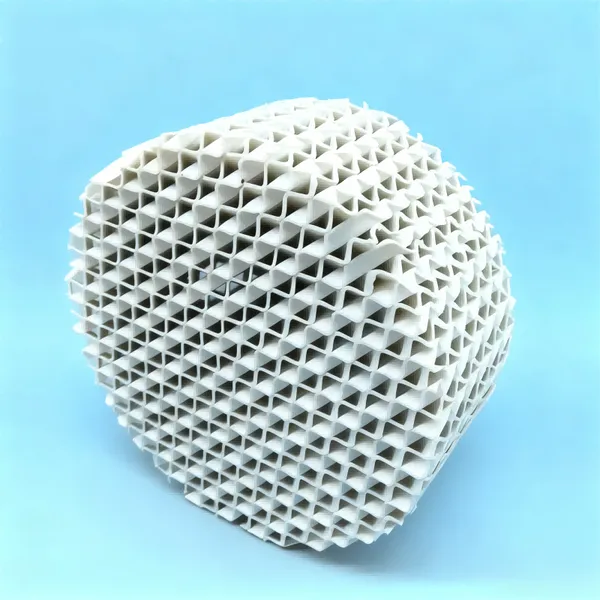
At Pingxiang Daier Separation Tech Co., Ltd. (spelled D-A-I-E-R) , we engineer light ceramic combination ring structured packing specifically for this replacement scenario. Manufactured at our primary facility in Pingxiang, Jiangxi, China — the country's industrial ceramics hub — this packing combines the installation convenience of random packing with the mass transfer efficiency of structured packing.
H2: The Engineering Alternative — Why Replace, Not Rebuild?
H3: Capital Efficiency
Retrofitting an existing tower with new packing delivers performance improvement at a fraction of the cost of new tower construction:
No shell modification required
Existing support grids and liquid distributors remain in service
Installation completed during scheduled turnarounds — zero additional downtime
H3: Performance Uplift
DAIER light ceramic combination rings deliver measurable performance improvements over legacy packings:
Higher void ratio (75–85%) reduces pressure drop
Higher specific surface area (118–135 m²/m³) increases mass transfer efficiency
Ordered stacking geometry eliminates channeling
Self-supporting feet maintain consistent bed voidage over time
H2: Material Science — Why Ceramic for Petrochemical Service?
Petrochemical towers operate in environments that challenge both metal and plastic packings:
| Material | Limitation in Petrochemical Service |
|---|---|
| Metal (SS304/SS316) | Corrosion in acid gas service; high cost for large-diameter towers |
| Plastic (PP/PVDF) | Temperature limit ≤150°C; deformation under thermal cycling |
| Ceramic (DAIER specification) | Temperature resistance up to 1100°C; acid/alkali resistance; chemically inert |
H3: DAIER Ceramic Composition
DAIER light ceramic combination rings are manufactured from high-purity acid-resistant ceramic materials:
| Parameter | DAIER Specification |
|---|---|
| Al₂O₃ + SiO₂ | ≥ 93% |
| Fe₂O₃ | ≤ 1.5% |
| Acid Resistance | ≥ 98.8% |
| Alkali Resistance | ≥ 85% |
| Mohs Hardness | ≥ Grade 7 |
| Maximum Operating Temperature | 1100°C |
This composition provides resistance to:
Mineral acids: HCl, H₂SO₄, HNO₃ (except HF)
Alkaline solutions
Organic solvents
High-temperature gas streams containing sulfur and chlorine compounds
H3: Thermal Stability
The low thermal expansion coefficient of the ceramic material minimizes dimensional changes during temperature cycling, preserving packing geometry and bed void fraction over the service life. Ceramic packing in acid service can achieve 10–20+ years of service life if thermal cycling is properly managed.
H2: Geometric Design — The Combination Ring Advantage
H3: Structural Architecture
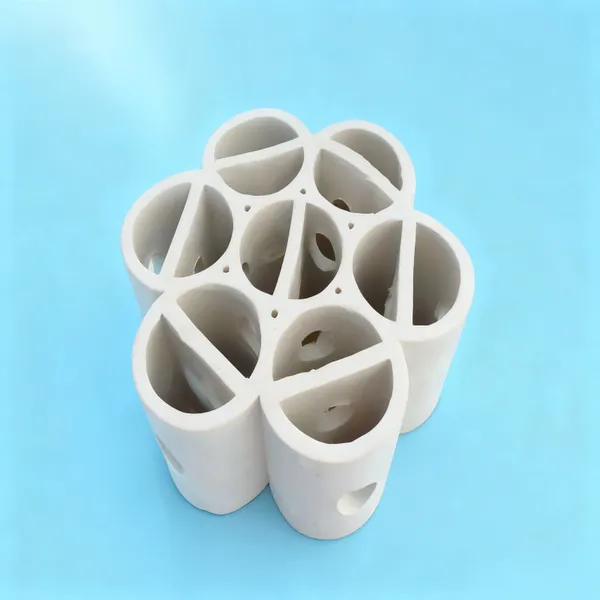
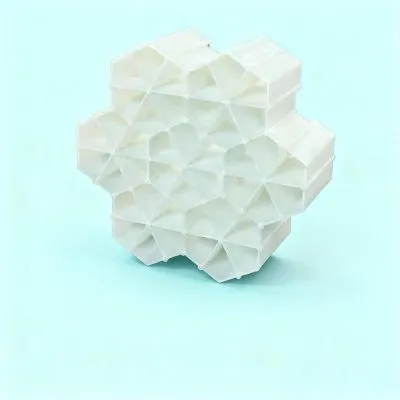
The combination ring features a multi-hole, multi-channel structure with integral support feet. When loaded into the tower, the self-supporting feet create a consistent gap between layers, ensuring:
Uniform gas distribution across the bed cross-section
Consistent liquid film formation on packing surfaces
Elimination of nesting and interlocking — a common failure mode in conventional ring packings
H3: Technical Performance Data
| Model | Size (mm) | Specific Surface (m²/m³) | Void Ratio (%) | Bulk Density (kg/m³) |
|---|---|---|---|---|
| Seven-Hole Interconnected Ring | 220×220×110 | 118 | 85 | ~800 |
| Seven-Hole Ribbed Ring | 220×220×110 | 128 | 75 | — |
| Seven-Hole Curved Ring | 220×220×110 | 132 | 75 | — |
| Six-Hole Hexagonal Ring | 220×220×110 | 120 | 80 | — |
| Hexagonal Multi-Hole Ring | 220×220×110 | 135 | 79 | — |
H3: Performance Characteristics
Low Pressure Drop: Void ratio of 75–85% minimizes gas-phase resistance, reducing energy consumption
High Mass Transfer Efficiency: Specific surface area of 118–135 m²/m³ maximizes gas-liquid interfacial area
Anti-Fouling Design: Open multi-hole geometry and smooth ceramic surfaces reduce solids accumulation
Mechanical Strength: High fired density and Mohs hardness ≥7 provide resistance to crushing and abrasion
H2: Petrochemical Applications — Where DAIER Combination Rings Deliver
H3: Primary Unit Operations
DAIER light ceramic combination rings are engineered for the following mass transfer operations in petrochemical and refining service:
Distillation — fractionation towers, crude oil atmospheric/vacuum distillation
Absorption — acid gas removal (HCl, SO₂, H₂S), CO₂ capture
Scrubbing — gas purification, pollutant removal
Stripping — VOC and dissolved gas removal from liquid streams
Drying — gas dehydration, solvent drying
H3: Specific Applications in Petrochemical & Refining
| Application | Tower Type | Service Conditions |
|---|---|---|
| Desulfurization | Scrubber / Absorber | H₂S removal, amine systems |
| Benzene Washing | Washer | Aromatic hydrocarbon recovery |
| Ammonia Washing | Scrubber | NH₃ removal from gas streams |
| Naphthalene Removal | Scrubber | Tar and heavy hydrocarbon removal |
| Decarbonization | Absorber | CO₂ removal from synthesis gas |
| Sulfuric Acid Absorption | Absorption Tower | SO₃ absorption |
H3: Industry Sectors Served
Petroleum Refining
Petrochemical Processing
Coking & Coal Chemical
Fertilizer & Ammonia Production
Fine Chemical Manufacturing
Metallurgical Gas Treatment
H2: Replacement Engineering — Case Study: Retrofitting an SO₃ Absorption Tower
H3: The Challenge
An SO₃ absorption tower in a sulfuric acid plant was operating with legacy ceramic Raschig rings. After years of service, the packing showed signs of:
Channeling and uneven gas distribution
Increased pressure drop across the bed
Reduced absorption efficiency approaching permit limits
H3: The Solution
The plant replaced the existing Raschig rings with DAIER light ceramic combination rings without modifying the tower shell, support grids, or liquid distributors.
H3: The Result
Industry data from similar ceramic packing replacements confirm the performance uplift:
Absorption efficiency improved by approximately 28%
Pressure drop reduced by approximately 31%
The replacement was completed during a scheduled turnaround — zero additional downtime
"Compared with traditional ceramic Raschig rings, advanced ceramic packings offer higher capacity and lower pressure drop."
H2: Installation & Operational Considerations
H3: Installation Best Practices
Pour packing gently to avoid breakage — do not dump from height >1 meter
Maintain consistent layer height across the bed cross-section
Ensure support feet are oriented to create consistent inter-layer gaps
No special tools required for installation
H3: Operational Life
Ceramic packing in petrochemical acid service can achieve 10–20+ years of service life if thermal cycling is avoided. DAIER's high-purity ceramic composition and dense fired structure minimize:
Thermal shock cracking during process upsets
Chemical attack from acid gases and condensates
Mechanical degradation from bed settling
H2: Engineering Support from DAIER
DAIER provides process engineering support beyond packing supply:
Packing Selection: Based on process conditions (temperature, pressure, media composition, flow rate)
Hydraulic Calculations: Pressure drop estimation, flooding velocity analysis, F-factor calculation
Tower Sizing: For new installations or retrofit evaluations
Installation Guidance: Technical drawings, layout support, on-site troubleshooting
All DAIER ceramic packing is manufactured under ISO 9001:2015 certified quality systems, with full material traceability and batch inspection documentation.
H2: Manufacturing & Logistics
DAIER operates with a coordinated structure:
Pingxiang, Jiangxi, China — primary manufacturing base, located in the country's industrial ceramics and chemical packing hub
Xiamen — export and international business center
Taiwan — technical support and engineering background
Standard sizes available from stock; custom dimensions supported per project requirements. Products are exported to Europe, North America, the Middle East, and Southeast Asia.
H2: Conclusion: Engineering the Replacement
Petrochemical tower retrofitting is not about "buying new packing." It is about engineering a performance upgrade within the constraints of an existing asset.
The light ceramic combination ring from Pingxiang Daier Separation Tech (D-A-I-E-R) addresses the core engineering variables of tower replacement:
Geometry — maximizes interfacial area and eliminates channeling
Void ratio — minimizes pressure drop and energy consumption
Material — provides thermal and chemical stability for petrochemical service
Replaceable design — enables retrofit without shell modification
When engineers specify DAIER ceramic combination rings, they are not specifying a commodity. They are specifying an engineered solution to a mass transfer problem — one that delivers measurable performance improvement within the existing tower footprint.
Recently Posted
-
Pingxiang Daier Engineering Guide: Optimizing Process Efficiency with Plastic Pall Ring in Scrubbers
September 18, 2026Introduction: The Engineer's Dilemma - Pressure Drop vs. HETPIn the design and retrofitting of chemical process systems, a com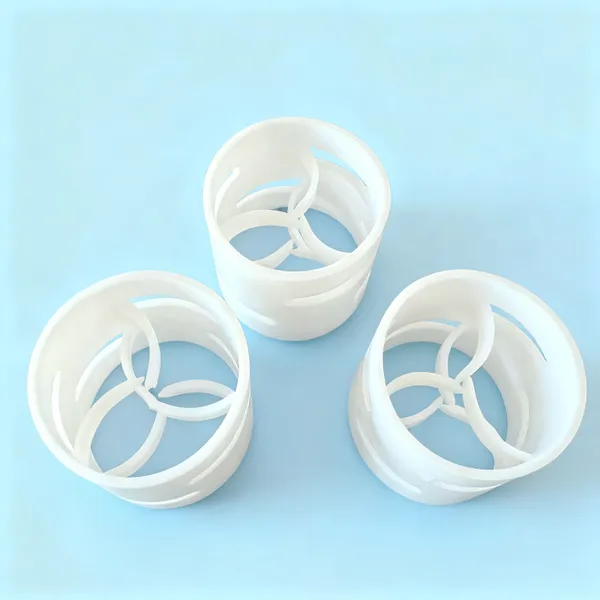 Read More
 -
Pingxiang Daier Engineering: How Ceramic Cascade Mini Rings Optimize High-Temp Acid Scrubbing Efficiency
September 18, 2026Introduction: The Engineering Limitations of Standard Packing in Aggressive EnvironmentsIn chemical process systems such as flue g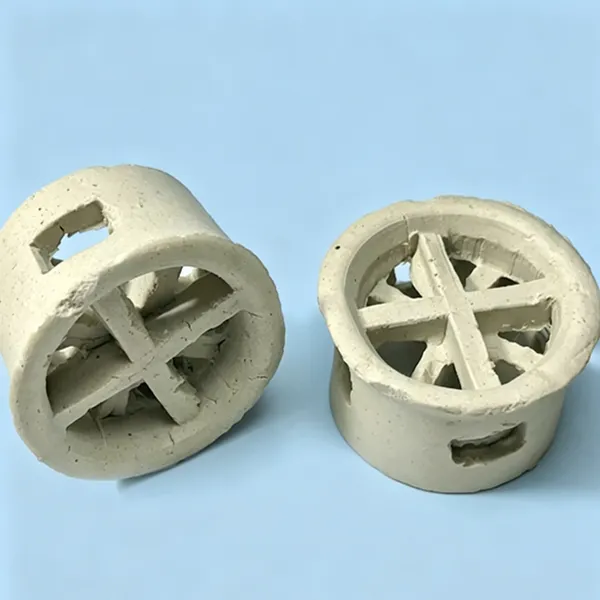 Read More
 -
Pingxiang Daier Engineering: How Plastic Super Intalox Saddle Rings Solve Scrubber Tower Bottlenecks
September 16, 2026Introduction: The Challenge of Capacity Bottlenecks in Scrubber TowersIn environmental engineering and chemical process systems, p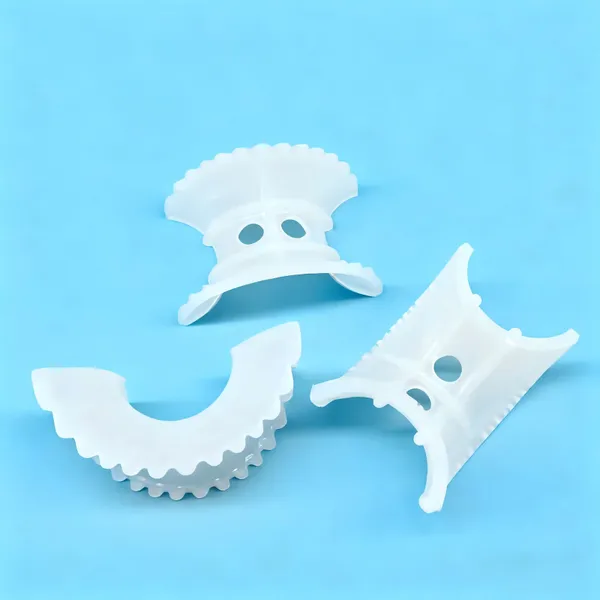 Read More
 -
Pingxiang Daier Engineering: Optimizing Gas Scrubbing Efficiency & Pressure Drop with Plastic Intalox Saddle Ring
September 15, 2026Introduction: The Engineering Challenge of Column InternalsIn chemical process systems, optimizing mass transfer while minimizing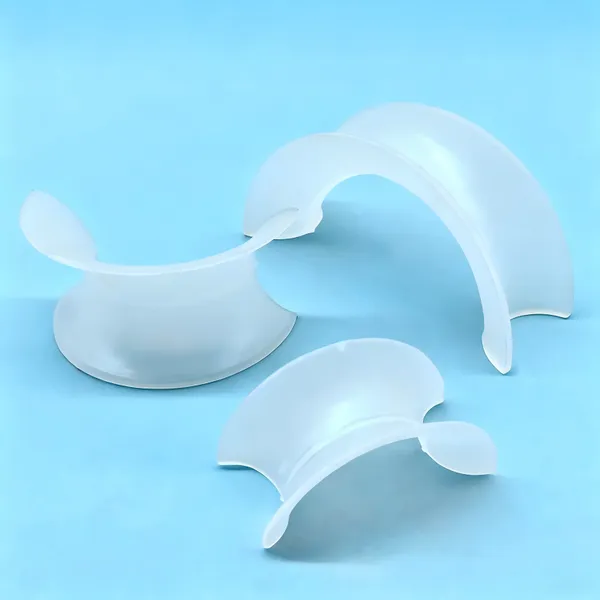 Read More

Contact Us
Recommended Products
-
 Pingxiang Daier Plastic Pall Ring | High-Throughput Random Packing for Gas Scrubbing & Mass Transfer SolutionsNegotiableMOQ: 1 Cubic Meter
 -
Pingxiang Daier Ceramic Berl Saddle | High-Temperature Acid Resistant Random Packing for Mass Transfer SolutionsNegotiableMOQ: 1 Cubic Meter
-
Pingxiang Daier Plastic Super Intalox Saddle Ring | High-Efficiency Random Packing for Advanced Gas ScrubbingNegotiableMOQ: 1 Cubic Meter
-
Pingxiang Daier Plastic Intalox Saddle Ring | Random Packing for Mass Transfer Solutions & Gas ScrubbingNegotiableMOQ: 1 Cubic Meter
-
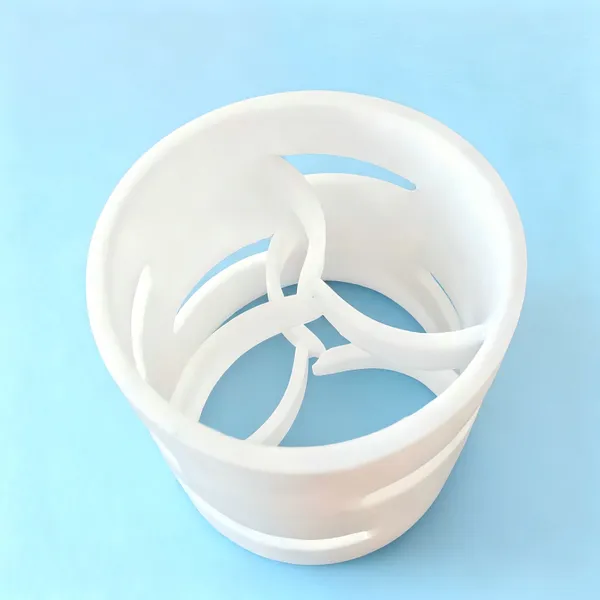
Pingxiang Daier Plastic Liquid Surface Cover Ball | Mass Transfer Solutions & Tower Internals | Chemical Process Systems OptimizationNegotiableMOQ: 1 Cubic Meter
-
Pingxiang Daier Plastic Floating Hollow Ball for Acid Storage Tank & Water Treatment | DAIER SeparationNegotiableMOQ: 1 Cubic Meter
-
Pingxiang Daier Plastic Heilex Ring Random Tower Packing for Gas Scrubbing & AbsorptionNegotiableMOQ: 1 Cubic Meter
-
Pingxiang Daier Plastic Cascade Mini Ring Random Tower Packing for Absorption & ScrubbingNegotiableMOQ: 1 Cubic Meter
-
Pingxiang Daier Plastic Polyhedral Hollow Ball Random Tower Packing for Scrubbing & AbsorptionNegotiableMOQ: 1 Cubic Meter
-
Pingxiang Daier Corundum Wear-Resistance Ceramics Rotating Scraper for Balling & Bulk Material Handling | DAIER SeparationNegotiableMOQ: 1 Cubic Meter
-
Pingxiang Daier Double Labyrinth Sealed Ceramic Conveyor Roller for Mining & Bulk HandlingNegotiableMOQ: 1 Piece
-
Pingxiang Daier Plastic Perforated Plate Corrugated Structured Packing 125Y 250Y 350Y for Distillation Absorption ScrubberNegotiableMOQ: 1 Cubic Meter
-
Pingxiang Daier Light Ceramic Combination Ring Structured Packing Replaceable for Petrochemical Distillation Absorption ScrubberNegotiableMOQ: 1 Cubic Meter
-
Pingxiang Daier Plastic Hexagonal Composite Ring Structured Packing PP/PVDF for Scrubber Tower Low Pressure Drop High Void RatioNegotiableMOQ: 1 Cubic Meter
-
Pingxiang Daier Metal Corrugated Plate Structured Packing 125Y 250Y 350Y 500Y 700Y for Distillation Absorption ScrubbingNegotiableMOQ: 1 Cubic Meter
-
Pingxiang Daier Ceramic Structured Packing 100Y-700Y for Distillation, Absorption & Acid Gas ScrubbingNegotiableMOQ: 1 Cubic Meter
-
Pingxiang Daier Medium Alumina Inert Ceramic Ball (Al₂O₃ 17-23%) for Catalyst Support & Tower PackingNegotiableMOQ: 1 Cubic Meter
-
Pingxiang Daier High Alumina Ceramic Ball for Quenching, Scrubbing & Drying Towers – Inert PackingNegotiableMOQ: 1 Cubic Meter
-
Pingxiang Daier 92% Al₂O₃ High Alumina Inert Ceramic Ball Tower Packing for Catalyst Support & Reactor BedNegotiableMOQ: 1 Cubic Meter
-
Pingxiang Daier 92% Al2O3 High Alumina Inert Ceramic Ball Tower Packing for Catalyst Support & DistillationNegotiableMOQ: 1 Cubic Meter